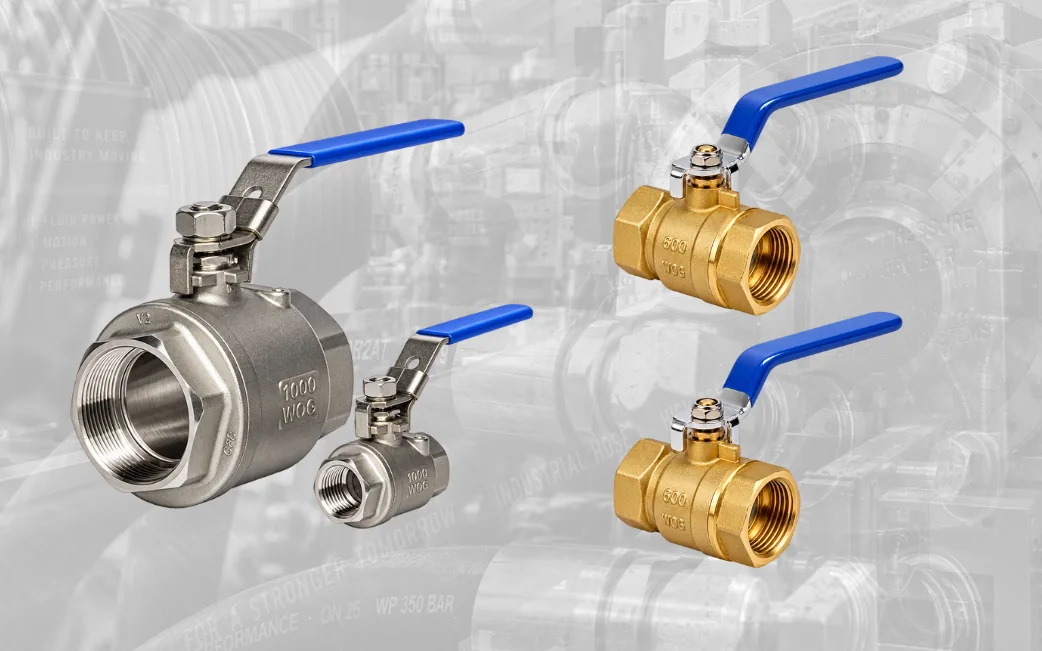
Choosing between a stainless steel ball valve and a bronze one looks like a budget decision, but it is really a decision about environment and fluid. In Panama, where humidity is constant and many installations sit a few kilometres from the sea, that difference shows up in service life much sooner than expected.
What is a ball valve and why is it so widely used?
A ball valve holds a drilled sphere inside. When the bore lines up with the pipe, flow passes; turn the lever a quarter turn and the sphere blocks the flow completely.
Its popularity comes from three things: it opens and closes fast, the bore is practically unobstructed —so pressure loss is minimal— and it seals well even after years in service. For full shut-off, it is the default choice in most industrial lines.
When is stainless steel the right call?
Stainless resists corrosion far better because it forms a passive chromium oxide layer that regenerates itself when scratched. It is the correct choice when:
- The installation is near the sea or exposed to salt spray. In coastal areas bronze pits visibly within a few years.
- You handle chemicals or products that would attack bronze.
- There is contact with food, beverages or drinking water, where metal pickup into the product matters.
- The line runs at elevated temperature or with steam.
- The valve is permanently outdoors.
The stainless steel ball valve costs more upfront, but in an aggressive environment it usually works out cheaper for the simple reason that it does not need replacing.
And when is bronze enough?
Bronze is still perfectly valid —and cheaper— in clean water, compressed air and general indoor services where there is no salinity or chemicals. In a building interior water network, for example, there is no technical reason to pay for stainless.
The mistake is not using bronze: it is using it where the environment will attack it and then blaming the valve.
What is a butterfly valve and when do I choose it?
As diameter grows, a ball valve becomes heavy and expensive. Beyond a certain size the logical alternative is the wafer butterfly valve: a disc rotating on its axis inside the pipe.
It is far more compact and lighter in large diameters, and mounts between flanges taking up almost no space. In exchange, the disc always stays in the flow, so it creates slightly more pressure loss than a full-bore ball valve.
In short: ball for small and medium diameters where free bore matters; butterfly for large diameters where weight, space and cost matter.
How do I install it so it lasts?
Three things make the difference and none of them costs money.
Do not use it to throttle. A ball valve is meant to be fully open or fully closed. Leaving it halfway concentrates flow on one edge of the sphere and erodes the seat; before long it stops sealing even when fully closed.
Cycle it occasionally. A valve that sits in the same position for years seizes up, especially if the fluid leaves sediment. Opening and closing it periodically during maintenance keeps it operational.
Watch the tightening torque. Overtightening deforms the body and can affect the ball seal; undertightening leaves a leak at the joint.
How do I know a valve is failing?
- It weeps at the stem even when properly closed: the stem packing has dried out.
- It does not shut off completely: the seat is eroded, almost always from being used as a throttle.
- It is hard to turn: sediment or internal corrosion.
- Green or white pitting on the body: advanced corrosion, and at that point it is no longer a question of whether it will fail but when.
If you are unsure which material suits your installation, message us on WhatsApp with the fluid, the diameter and where it is mounted. See the full range under valves and equipment.