Camlock and Chicago are the two most widely used quick-coupling systems in industry, and they are often confused because both connect and disconnect without tools. But they are designed for different fluids, and using them the wrong way round is not a minor detail: it is a real safety risk.
What is a Camlock coupling?
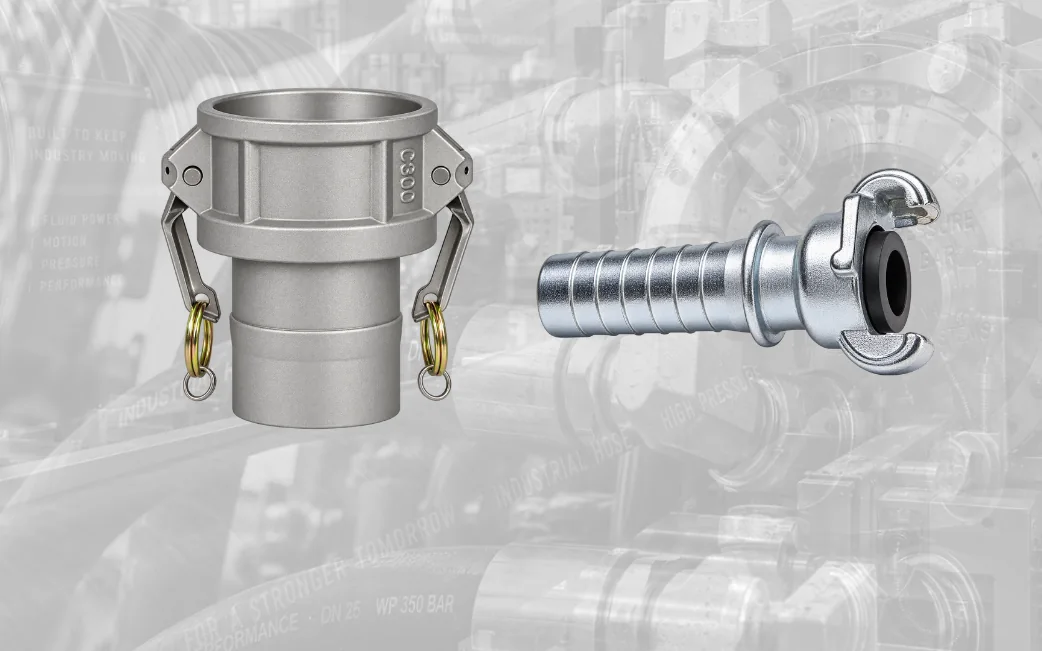
The Camlock —also called cam-and-groove— joins two halves: a female with two cam arms and a male with a groove. As the arms come down, the cams pull the male against a gasket and the assembly seals.
It is the standard for liquids: water, fuel, oils, chemicals, food products. It connects in seconds, needs no tools, and its seal depends on a gasket that can be replaced separately.
Types are identified by letter according to the end combination. The most common are A, B, C, D, E and F, plus the DP and DC plugs and caps that close the line when not in use.
What is a Chicago coupling?
The Chicago —also known as universal claw or lug coupling— is a symmetrical coupling: both halves are identical. They engage with a quarter turn and are secured with a pin or a cable.
It is the standard for compressed air and, to a lesser extent, for pressurised water on site. Its advantage is that there is no male or female: any end connects to any other, which greatly simplifies logistics in a workshop or on a job site.
You will find them in male, female and hose-end versions, depending on how they integrate into the line.
When do I use Camlock and when Chicago?
The short rule: Camlock for liquids, Chicago for air. Expanded:
- Camlock when transferring liquids, when you need a tight seal, and when the line may stay pressurised for long periods.
- Chicago when working with compressed air on pneumatic tools, breakers or temporary site lines.
Camlock is not designed for high-pressure compressed air, and Chicago does not provide the tight seal that fuel or chemical handling demands.
Why is compressed air more dangerous?
This is the most underestimated point. Air is compressible: a pressurised line stores energy like a loaded spring. If a coupling lets go, the hose whips away violently and unpredictably until it empties.
A liquid, by contrast, is practically incompressible: when a joint releases, pressure drops immediately and the hose barely moves. It is a spill, not a whip.
That is why every air line with Chicago couplings should carry a whip check safety cable between the two halves. It is an inexpensive accessory that turns a serious accident into a scare. We cover it in detail in the article on safety in air and water lines.
Which material should I choose?
Aluminium is the most common: light, economical and sufficient for water, air and many fuels. For aggressive chemicals, salt water or food industry use, stainless steel resists corrosion far better — and in Panama coastal environment that is not a theoretical concern.
One detail often forgotten: the gasket has a material too. A buna seal works for water and common oils, but an aggressive chemical may require viton or PTFE. Replacing the seal is cheap; replacing the whole line because the chemical attacked it is not.
Common mistakes with quick couplings
- Connecting Chicago without the whip check cable. The most dangerous mistake on this list.
- Reusing a hardened gasket. Once it loses elasticity it no longer seals, even if it looks intact.
- Mixing materials unnecessarily: aluminium with stainless in the presence of salt water accelerates galvanic corrosion.
- Disconnecting a pressurised line. Always depressurise before opening the cam arms or the pin.
- Forcing a coupling that will not engage: if it does not fit, it is the wrong type.
If you need help identifying which coupling type your line uses, send us a photo on WhatsApp. You can see the full range under industrial couplings.