The whip check cable is one of the cheapest accessories on a compressed air line and, by a wide margin, the one that prevents the most serious accidents. It costs very little, and its absence is one of the most common causes of serious injury on site and in the workshop.
What is a whip check cable?
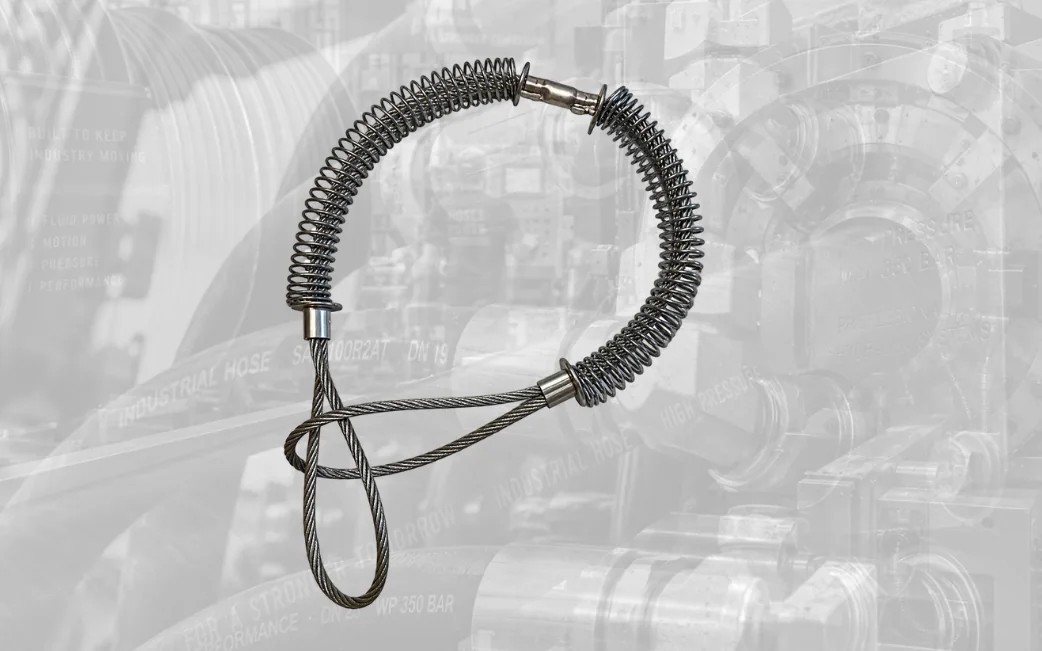
It is a steel cable with a loop at each end, fitted across the joint between two hoses, or between the hose and the equipment. Its job is not to stop the coupling from releasing: it is to limit how far the hose can travel if it does.
It installs in seconds, does not interfere with the work, and needs no maintenance beyond checking it is not cut. See it in the whip check safety cable listing.
Why is compressed air so dangerous?
Because air is compressible. A pressurised air hose stores energy like a loaded spring: there is far more air inside than that volume would hold at atmospheric pressure.
When a coupling releases, all that air expands at once and pushes the hose. The free end —with a metal coupling on the tip— whips violently and unpredictably until the line empties. Blows to the head, face and hands are the typical injuries.
With a liquid it is different: being practically incompressible, pressure drops immediately when the joint releases. It spills, but it does not whip. That is why the whip check requirement is so strict on air and not on low-pressure water.
Where exactly should it go?
At every joint on the line, not just the first one:
- Between the compressor and the first hose.
- At every hose-to-hose joint.
- Between the last hose and the pneumatic tool.
A line with five sections needs whip checks at all five joints. Fitting just one gives a false sense of security: if the third joint releases, the cable on the first does nothing.
How is it installed correctly?
The cable should sit taut but not strained, crossing the joint so that if the coupling gives way, the cable stops the hose before it picks up speed. A cable fitted with too much slack lets the hose accelerate and hit the end of its travel hard; one fitted too tight can pull on the joint during normal work.
The loops go around the hose, not around the coupling: if the coupling is what fails, a cable attached to it goes with the hose.
What other measures go with it?
The cable is the last line of defence, not the only one. What really reduces risk is the coupling not releasing in the first place:
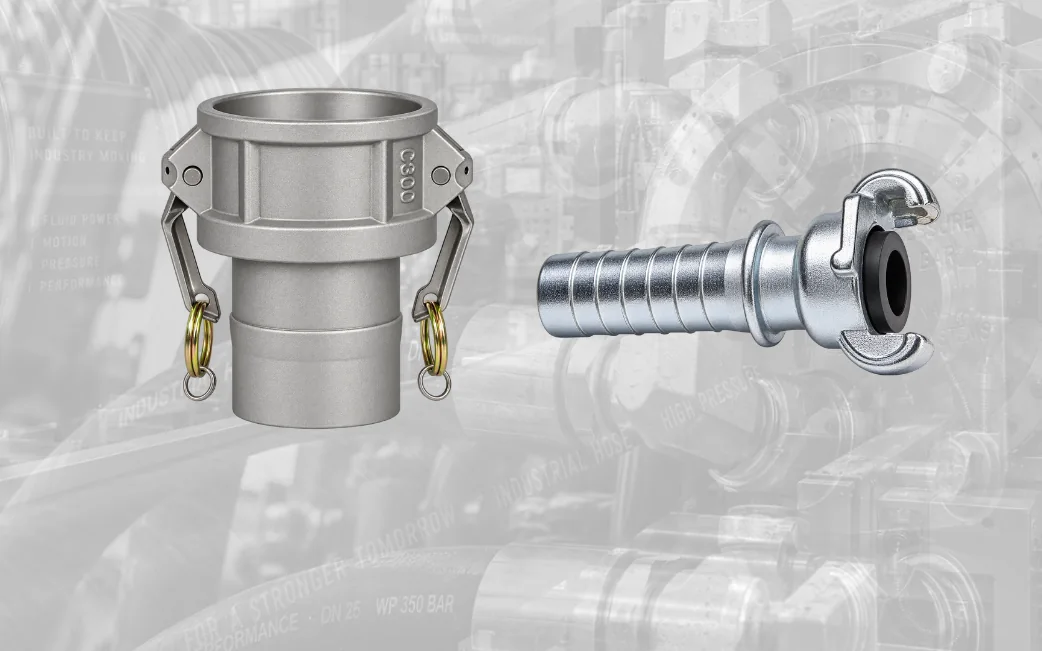
- Secure the pin on Chicago couplings. A claw coupling without its pin can rotate and release from vibration alone.
- Depressurise before disconnecting. Never open a joint on a charged line.
- Check the gaskets: a worn one not only leaks, it also allows play in the joint.
- Replace damaged hoses instead of repairing them with tape.
What about pressurised water lines?
Although the whip risk is much lower, on high-pressure water —pressure washing, hydrostatic testing— securing the joints is still good practice. A pressurised jet also causes injury, and a loose hose can knock over equipment or a person.
If you are unsure which cable size suits your hose, message us on WhatsApp with the diameter. You can see the rest of the safety accessories under valves and equipment, and review the difference between coupling systems in Camlock vs Chicago.