Industrial hoses rarely fail suddenly. They almost always give warning for weeks before bursting, and the problem is that nobody looks at them until it is too late. A five-minute inspection per shift catches most failures before they cause downtime or an accident.
What do I check in a visual inspection?
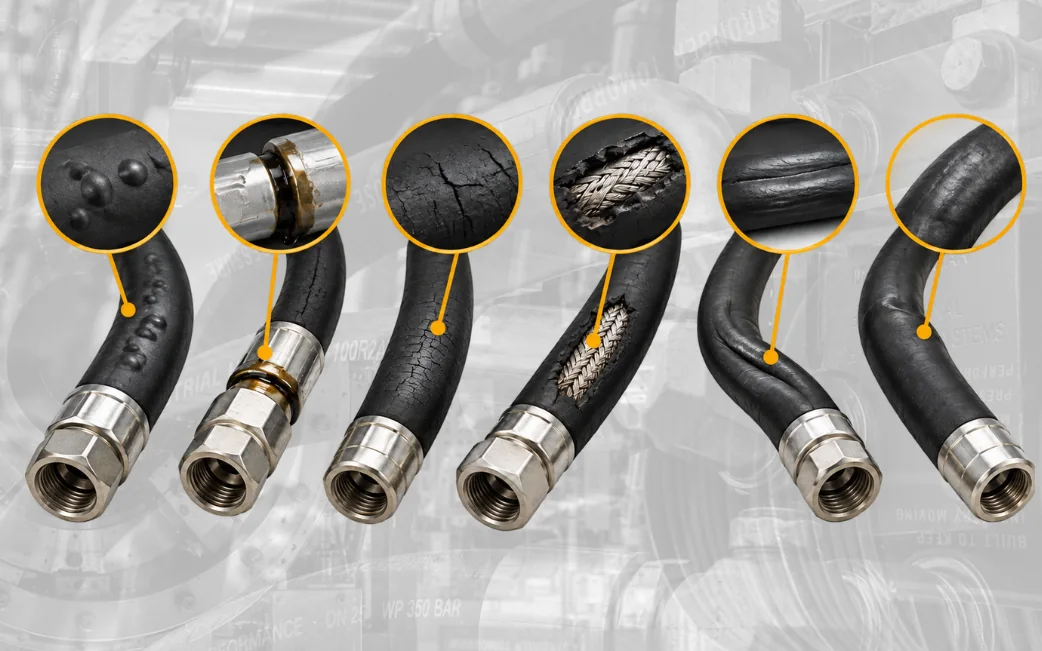
Nothing needs dismantling. With the line depressurised, run your eyes and your hand along the hose looking for:
- Blisters or bubbles on the cover. They mean fluid has seeped between the inner tube and the reinforcement. Immediate replacement.
- Weeping at the ferrule. An oil film around the fitting means the crimp is giving way.
- Cracked or dried-out cover, especially on hoses working in the sun.
- Exposed steel reinforcement from abrasion. Once exposed it rusts, and rust does not hold pressure.
- Flattened or twisted sections that do not recover their shape.
- Abnormal stiffness: if a section feels hard compared with the rest, the inner tube is degrading.
How should a hose be routed?
A large share of premature failures are not about the material but the installation. Four rules solve almost everything.
Respect the minimum bend radius. Every hose has its own, listed in the datasheet. Bending tighter collapses the reinforcement from the inside, even if nothing shows on the outside.
Leave slack. A hose contracts when pressurised. Installed taut, every pressure cycle pulls on the fitting until it tears away.
Avoid twist. A twisted hose loses a significant part of its service life. When installing, check that the cover marking runs straight and not in a spiral.
Protect against abrasion. Wherever the hose touches a structure, fit a spiral guard or sleeve. It is cheaper than the hose.
How often should I inspect?
It depends on service severity, but a reasonable scheme is:
- Every shift: a quick look at the most critical hoses and known abrasion points.
- Weekly: a full walk-through with the line depressurised, checking ferrules and bends.
- At every scheduled maintenance: review of fittings, torque and clamp condition.
What matters is not the exact frequency but that it is systematic. An inspection that depends on someone remembering is not a maintenance plan.
Can a hydraulic hose be repaired?
A hydraulic hose with a punctured cover, blisters or exposed reinforcement is not repaired: it is replaced. Any patch over damaged reinforcement is a failure waiting to happen, and at the pressures these circuits run, that failure is dangerous.
A pipe with a localised leak is a different case, where a repair clamp is a legitimate solution —temporary or permanent depending on the situation. We cover it in the guide on repairing leaks with clamps.
How should spare hoses be stored?
Bad storage ages a hose before it is ever used. In Panama climate this matters especially:
- Keep them in the shade: ultraviolet radiation dries out the cover.
- Coiled without sharp bends, never hung from a hook that concentrates weight at one point.
- With the ends capped so dust and moisture do not reach the inner tube.
- Rotating stock: use the oldest first. Rubber ages even if the hose was never installed.
What to do when a hose fails
Before replacing it, spend a minute understanding why it failed. If it burst at the same point where another one already failed, the problem is not the hose: it is the routing, the abrasion or a vibration nobody has corrected. Swapping the part without fixing the cause only buys a few weeks.
If you want us to review a hose before deciding, send photos on WhatsApp: with the cover marking and an image of the damage we can tell you whether it needs immediate replacement and which option from the catalog fits.